Today's entry is a real treat for the Marisa
Mell Blog! André Schneider from Berlin (Germany), a gifted actor, director, producer, musician,
and writer and above all a huge Marisa Mell fan, has granted me permission to pubiish his
reviews of several key Marisa Mell movies. "And what may be so special about his reviews?", you ask! Well, most movie reviews in magazines and other publications like blogs are mostly written by non-professionals from the métier
of film making. So they are very often written in the same way, using the same
language and style or are writing from the same point of vue: the lay man going to the
movies. The fact that André Schneider is a professional film maker gives the
reviews extra depths and layers that not often are found in movie reviews. And in
combination with André Schneider's profound knowledge of movie history from all
genres in the field makes the reviews a must read for every Marisa Mell fan or movie fan in general!
The first movie André Schneider is going to review is one of his favorite
Marisa Mell's movies, if not the favorite one: "La Encadenada" or
"Diary of an Erotic Murderess". Enjoy!

Diary of an Erotic Murderess
Originaltitel: La encadenada/Perversione;
Regie: Manuel Mur Oti; Drehbuch: Emilio Martínez Lázaro, Manuel Mur Oti, Rafael
Moreno Alba, Mario Siciliano; Kamera: José Luis Alcaine; Musik: Carlo Savina;
Darsteller: Marisa Mell, Richard Conte, Anthony Steffen, Juan Ribó, Richard
Baron. Spanien/Italien 1975. IMDb.
La Encadenada
1970 befand sich Marisa Mell in Italien im
Zenit ihrer Popularität. In den kommenden fünf Jahren spielte sie in
etwa 20 Filmen, von denen die meisten heute (leider zu Recht) in Vergessenheit
geraten sind. (Lediglich den an diverse Hitchcock-Klassiker angelehnten
Thriller »Marta« (Regie: José Antonio Nieves Conde) mit Stephen Boyd sollte
man, wenn sich die Gelegenheit bietet, wirklich anschauen.) »La encadenada« war
der zweite von insgesamt drei Filmen, die die Österreicherin Anfang der
siebziger Jahre in englischer Sprache für die spanische Produktionsgesellschaft
Emaus drehte. Für die internationale Auswertung bekamen die Emaus-Filme
allesamt lächerlich reißerische Titel verpasst: aus dem interessanten »Pena de
muerte« (Regie: Jorge Grau) mit Fernando Rey wurde »Violent Blood Bath«, aus
»Infamia« (Regie: Giovanni d’Eramo) »Death Will Have Your Eyes«, und aus Manuel
Mur Otis »La encadenada« (wörtlich: »Die Angekettete«) schließlich »Diary of an
Erotic Murderess«. Das ändert jedoch nichts an der Tatsache, dass gerade diese
drei Mell-Filme die mit Abstand sehenswertesten aus dieser Zeit sind; »La
encadenada« dürfte sogar ihr schönster Film aus den Siebzigern sein.
Unglücklicherweise wurde das kleine Juwel bis zum heutigen Tage im
deutschsprachigen Raum nicht zur Aufführung oder gar in den Verleih gebracht.
(Eine um ca. acht Minuten gekürzte US-Version des ursprünglich 94 Minuten
langen Streifens wird kostengünstig von diversen Internethändlern auf DVD-R
angeboten.)
Nur ganz kurz zur Handlung: Der
Tod der Mutter ließ den Millionärssohn Marc (Juan Ribó in seinem Filmdebüt)
plötzlich verstummen. Mit seinem erratischen Verhalten terrorisiert er die
Hausangestellten. Nachdem er mal wieder eine Gouvernante vergrault hat,
engagiert sein Vater, der Industrielle Alexander (Richard Conte in seinem
vorletzten Filmauftritt), die attraktive Psychologin Gina (Mell), die sich
fortan verständnisvoll um den Jungen kümmert. Doch die junge Frau birgt ein
düsteres Geheimnis: sie ist keine Psychologin, sondern eine verurteilte Diebin auf
der Flucht vor ihrem gewalttätigen Ehemann (Italo-Western-Ikone Anthony
Steffen), der ihr bereits dicht auf den Fersen ist. Im weiteren Verlauf der
Geschichte spielen ein benachbartes Templerkloster, der Heilige Gral, ein
geheimnisvolles Tagebuch, ein Gasmord in der Badewanne, Lügen, Erpressung,
Besessenheit und der Drang, sich aus einem Netz von Intrigen und Habgier zu
befreien, wichtige Rollen.
In keinem anderen Film ist Marisa
Mell so atemberaubend schön und geheimnisvoll wie in diesem. Kameramann Alcaine
weidet sich förmlich an ihrem großflächigen, makellosen Gesicht mit den leicht
schräg gestellten grünen Augen, den vollen Lippen und dem markanten Kinn, Carlo
Savinas zarte, in diesem Gefüge wie eine Liebeserklärung wirkende Klaviermusik
untermalt Bilder, die so erlesen sind, dass man sie ausdrucken, einrahmen und
an die Wand hängen möchte. Bei so viel Ästhetik vergibt man gern die zahllosen
Wendungen des überfrachteten Drehbuchs — ja, es ist tatsächlich noch von
galizischen Hexen die Rede! —, die logischen Brüche und die platte,
zeittypische Psychologie.
Dass Manuel Mur Oti seinen Produzenten den
fertig geschnittenen Film bereits am 15. März 1974 vorlegte, lässt darauf
schließen, dass die Dreharbeiten schon Ende 1973 stattgefunden haben müssen.
Mit diesem Werk, das damals schon ein wenig altmodisch gewirkt haben muss,
stieß er auf Unverständnis, und so hatte »La encadenada« einen langen und
harten Weg zurückzulegen, ehe er dem Publikum zugänglich wurde. Emaus schien
nicht recht zu wissen, was sie mit dem Film machen sollte und entschied sich,
ihn zunächst in Italien auf den Markt zu bringen. Am 30. November 1974 wurde
»La encadenada« dem italienischen Produktionspartner Metheus Films übergeben
und startete unter dem Titel »Perversione« im Mai 1975 ohne große Anteilnahme
der Öffentlichkeit in den italienischen Kinos. Erst im Januar 1977 war die
Madrider Premiere, und leider lief der Film nur mäßig: Die Emaus verzeichnete
einen mickrigen Bruttogewinn, der heute in etwa 73.750 Euro entspräche. Kein
Wunder, dass die Produktionsfirma das Jahr 1977 nicht überstand und Konkurs
anmelden musste.Mur Oti drehte hiernach nur noch einen Film, »Morir … dormir …
tal vez soñar«, um 1979 in den wohlverdienten Ruhestand zu gehen. Zehn Jahre
vor seinem Tod ehrte die spanische Filmakademie den inzwischen 85jährigen
Galizier mit einem Goya, dem spanischen Äquivalent zum Oscar, für sein
Lebenswerk. Ein verkannter Meister — grandios: »Un hombre va por el camino«
(1950) und »Cielo negro« (1951) —, der nur 17 Filme inszenieren konnte und dem
viel zu spät Tribut gezollt wurde. Im Rahmen einer Retrospektive wurde »La
Encadenada« im August 1999 wiederaufgeführt und erfuhr schließlich die
Zustimmung des Publikums, die ihm fraglos zusteht.
Vielerorts wirft man dem Film
sein behäbiges Tempo vor, seinen Mangel an Blutrünstigkeit und Sex. Für einen
handfesten Thriller fehlt es an Spannung, für einen Giallo an Titten, für ein
Psychodrama an Tiefe. Mancher Rezensent sprach von einer Seifenoper.
Giallo-Experte Christian Keßler, der ansonsten für praktisch jeden Film lobende
Worte findet, bezeichnete »La encadenada« in seinem Verriss als »morbides
Erotikdrama«. In meinen Augen ist das Werk ein dunkles Märchen, dem man sich
aufmerksamen Blickes und mit angemessener Behutsamkeit nähern sollte. Tut man
dies, wird man reich belohnt. Ein Film, in dem mehr steckt — viel mehr! —, als
es auf den ersten Blick scheint.
André Schneider
27.03.2011
//
Thanks for the first review! It is highly appreciated!
//
If you like to read more reviews about almost every genre of movie you can follow André Schneider's personal movie blog:
http://vivasvanpictures.wordpress.com/
Highly recommended!


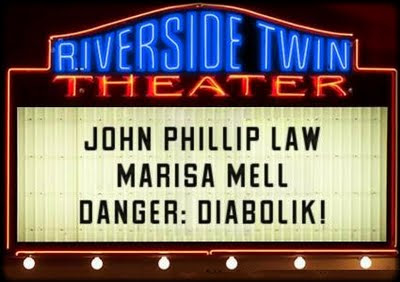
 While in Paris (France) last week and the beginning of this week, I was walking one night along the Boulevard de Strassbourg. During this walk I was happy to see that some traditions have not (yet) died out in our present day society! What am I talking about? Well, along the Boulevard there is a nice little cosy theatre, as there are still many in Paris, but this one still had a big old style marquee on its front wall like in the old days with the name of the actress/cabaretière on it in bright big lights together with the name of the programme that she was bringing. In the last century, theatre and movie marquees were "the" way to announce a programme. Sadly, when a lot of theatres and cinemas were replaced by modern movieplexes and big concrete theatres these often beautiful crafted marquees disappeared to be replaced by dull displays.
 So during my walk I wondered what it would be like to see a Marisa Mell film on a movie marquee during the end of the 60's and the beginning of the 70's when these were still around. Unfortunately, to my knowledge, there excist no pictures of these movie marquees with a Marisa Mell movie on it but thanks to the magic of the internet I created these marquees to get a sense what they might have looked like in the past!
 Sometimes other Marisa Mell-fans ask me what my favorite movie poster is of a Marisa Mell movie. Well there are several movie posters that are in my top 10 like the mega posters for "Una Sull'Altra", both versions, the black one and the green one, where Marisa Mell and co-star Elza Martinelli are both depicted in stunning art work and very life like or the giallo version of the movie poster for the excellent "La Encadenada" with another beautiful rendition of Marisa Mell in a vortex of fear. But when you ask me what is in my opinion the best set of movie posters and lobby cards then it has to be the Italian locadine of the 1966 cold war spy movie "City of Fear". This set of movie posters and lobby cards has it all. Stunning art work of Marisa Mell on two of the three movie posters, vibrant colors, action scenes, vintage cars and in the vein of the James Bond craze from that moment a mega gun with a silencer. Can you ask for more? Although the movie was shot in black and white the lobby cards are all re-colored in lively colors almost all depicting a beautiful Marisa Mell as she appeared in the movie! Simply the best set!


