Dear reader, this entry for now will be the last entry because I am going abroad for the month of February 09. I will probably be back at the end of that month! Therefore I have made a longer entry than normal so you have a little something to read during my absence! I'll send you all a postcard from Marrakech (Marocco)! Enjoy! Mirko di Wallenberg
Marisa Mell was a beautiful 26 year old young women in 1965 when the sixties were in full swing. She was enjoying her life very much. Things were finally coming togethe

r. Her career was in the lift after her latest movie “Masquerade” with international stars Cliff Robertson and Jack Hawkins. Dreams of being an international movie star, what she always wished for from the first day she entered drama school in Vienna, were becoming a reality. Important producers were taking notice of the Austrian actress with the chess nut brown long hair, the piercing emerald green eyes and voluptious lips. Austria and Germany, untill then her most important movie markets, were becoming to claustrophobic. Life had so much more to offer on each level and Marisa Mell longed to discover it all, one way or the other. She was ready for the next big step in her career and life! So when the offer came from producer Carlo Ponti, husband of actress Sophia Loren, to work in Rome (Italy) for the production of his next movie “Casanova 70” with Italian mega star Marcello Mastroianni she could not believe her luck. Although her part in the movie was a gloryfied one, with other Euro stars like Michèle Mercier of “Angelique” fame and future co-star Virna Lisi, in “Le Dolci Signore” (1968), it was definitely an A-movie so it could be a major boost for her career.

When arriving in Rome, Marisa Mell was not the only Austrian actor there at that moment. Among the incrowd was also her fellow country man Helmut Berger who had arrived in Rome in 1964 after having spend several years in swinging London. He also wanted more from life than his endeavors in London. Shortly after being in Italy, Helmut Berger had, on a fatefull day, an encounter that would change his life completely forever. Together with a friend he made a stop in Voltera, near Florence, on his  way to Assisi, where he would study the architecture. During their lunch break, Luchino Visconti, a world famous Italian director, was filming his latest movie “Sandra” with Italian star Claudia Cardinale not far from the restaurant. Helmut Berger watched the filming during the entire day and at the end of that day, Visconti made acquantaince with the beautiful young man. Visconti, officially “Don Luchino Visconti di Modrone, Duc of Lonate Pozzolo”, was a member of one of the most important and wealthy aristocratic families in Italy. He fell in love with Helmut Berger within days after their chance meeting and they became lovers in a marriage like relationship untill his untimely death in 1976. Due to his liaison with Visconti, Helmut Berger had immedia
 te access to money, wealth, jet-set and the aristocratic circles in Rome of the sixties. When looking back it is ironic to see on the Visconti weapon the dragon snake (symbol of the Visconti family since the 14th century) eating his enemy. After the death of Luchino Visconti, Helmut Berger was immediately dropped by the family and left in the cold with very little money due to the absence of a testament by his partner. The years following this tragedy Helmut Berger needed more than 10 years to recover from the loss of his partner. Alcohol and drugs were for a very long time his only home. Since that day his career went nowhere and even today he has never reached the heights again that it had as an actor when working with his lover. Their movies like "The Damned" and "Ludwig" are regarded today as true modern classics at the top of European cinema! So in the mid sixties two Austrian actors came to the Eternal City! You can imagine that for Marisa Mell coming from a mostly rainy dreary city like Vienna, Rome was the capital of sunshine and modern life. Freedom in every way! The best of it
 all was that she was getting payed for staying, working and partying. How much better could life become??? After work, it was party time in warm fashionable Rome! The Italians always knew how to party and enjoy life to the fullest. B
 eing a beautiful women, even to Italian standards, the Italian jet-set composed of aristocracy, artists, playboys and playgirls, politics and gangers fell quickly in love with "La Mell" . They embraced her as one of their own and she became very quickly after her arrival the talk of the town. The invitations to exclusive gatherings, partys, clubs and night clubs came in by the buck load. So after her arrival she met her fellow country man Helmut Berger in those cirlces, befriended him and with his connections to a member of the Visconti family it opened many doors for her also. They were at that moment the most beautiful couple in town. Who could beat them??? It was only natural that they were attracted to each other! Beauty attracks beauty! But that was not enough! The best was yet to come for Marisa Mell when she met, probably thanks to Helmut Berger and his artistocratic circle, the most wanted playboy of all in Rome with the name "Pier Luigi Torri". He was a fixture in Roman society at that moment. He was a young, eligible bachelor from an aristocratic family, just like Luchino Visconti. As a young man he was involved in the production of several soft-porn Italian movies. Whenever his picture appeared in the Italian yellow press, he was listed as "Torri, the movie producer". In reality however, Torri was one of those people who were mostly famous for being famous. His background, style and propensity for trouble all made him an eminently reportable personality. As mentioned Pier Luigi Torri was known as a grand playboy and a jet-set figure. He seemed to spend his time in the most glittering and expensive casinos and nightclubs in Italy and Monte Carlo. He
 won and lost millions of Italian lira at the gambling tables. He owned several houses and villa's, his yacht was reported to be one of the largest and fanciest in the world. The story goes that one time he was approched by Prince Rainier of Monaco to buy the yacht! Torri refused and got the wrath of the Prince for the rest of his life. He drove Rolls-Royces and Ferraris. Another story from 1963 tells from an evening at a nightclub "Cabala" in Monte Carlo were Torri gratuitously insulted a woman who approached him in the club. When he didn't get the appropriate response to his insult, he escalated the abuse further until a gentleman in her group threw a punch at Torri. To escape the attack, Torri, who was more a lover like Casanova, not a fighter, fled by leaping over people and tables, as he went, all eyes in the club were upon him. Once across the room he climbed some stairs to a small door and lunged through it. The door however, was not an exit from the club but rather an access port to the building's chimney. Torri re-emerged covered in soot, dizzy from smoke and with singed hair. The clientele roared with laughter and applauded his comeuppance. The incident was reported in all the newspapers next day. From that day, Torri became the star of the Italian society press. Meeting this man was for Marisa Mell a revelation. Not only was he extremely wealthy but he was the man of her dreams. The beginning of a very turbulant relationship was eminent. Deep down they were what we now call soul mates and they were made for each other untill the very end!
 Torri and his business partner Bino Cicogna always had a dream of running their own nightclub. A club that would be truly unique. First they located an obsolete war ship and planned to place it fully-refurbished with all amenities in the harbour at Basilia. Their plan was to create an exclusive gambling casino for the European trash/cash set. Their idea gave a great deal of press coverage to Torri and Cicogna as they attempted to put the deal together. It didn't work out in the end ! One of the fancier clubs in Rome at the time was called "Number One" located on the now famous Via Veneto. This nightclub was the place to be during the height of the dolce vita. This is where Torri and Bino spent much of their time. The club was managed by another well known playboy called "Vassallo". Vassallo attended artfully to the whims and fancies of his want for nothing clientele. Years before Club 54 in New York, he pioneered the practice of roping off part of the club for the exclusive use of those who qualified as VIPs. Marisa Mell and Pier Luige Torri were on top of that list. So they had always free entrance.
 In the mid sixties, next to partying, another ugly beast begane to raise its head: The Big C. or Cocaine. A nightclub as "Number One" could not resist this temptation. The motto was: "What the costomer wanted, the customer got". Cocaine became the fancy drug. The jet-set believed that it enhanced love-making and the wide-open sexual practices. Orgies and every variation on love making was the centre piece of a lot of conversations and activities. People seated in the VIP lounge could signal their desire for some white powder by ordering certain code drinks. For example
 a gin fizz would bring the drink to the table but also a packet of coke costing an additional fiftythousand Italian lira (a lot of money at that time in regard to a normal monthly pay check). Bino Cicogna, Torri's partner, became totally involved in the 'coke' scene with an addiction so great that his nose and mouth began to show signs of collapse and disintegration. Bino was so far gone that he made a final desperate attempt to divorce himself from the drug and the entire scene that was destroying him. He fled to Rio de Janeiro (Brazil). Within a few weeks after his arrival in Brazil, he was found dead, with his head inside a plastic bag in an oven. After investigation, the conclusion was that he committed suicide in despair of his failure to cure himself. There was much speculation that Bino had been murdered because a clean, rehabilitated and sober Cicogn
 a Bino would return to Italy to expose or denounce drug distribution at "Number One". Torri was devastated by the loss of his best friend and firmly believed he had been murdered. Not content to grieve alone, he went to the club one night and positioned himself in a prominent place. Calling for silence he announced to the assembled visitors that, Bino Cicogna was dead. "He was my greatest friend." He did not stop there. On and on he went with his rhapsody of grief accusing his listeners of being the cause of Bino's death. Finally, in a histrionic frenzy, he raged at the crowd, "I will destroy all of you!" The link between Bino Cicogna's supposed drug-related death and Torri's accusation at Number One solidified the rumors flying around Rome that drugs were being served in the club. It was the beginning of the end of the club. The police finally decided to act on the accusations. One night while Vassallo was away in Paris (France), the nightclub was raided. Cocaine was found on the premises. Many people in the club were arrested, many of them rich, influential and famous. A police investigation was commenced into all regular patrons of "Number One". The police anxiously awaited Vassallo's return to Rome. They staked out all the airports hoping to apprehend him. He arrived at Fiumicino Airport and the police followed him as he drove his yellow Volkswagen to his lawyer's office. When Vassallo went inside, the police removed his car and conducted a search. Under the car battery, they discovered a sizable quantity of cocaine. Subsequently, they claimed that the chemical composition of the drug in Vassallo's car was exactly the same as that found in the nightclub. He was immediately taken into custody for questioning. He had an exculpatory explanation for the drugs. He told the police and the media was, "I've been framed. Torri hates me. He planted the drugs in my car and at the club to make good on his threat to destroy me." The judicial system in Italy now had a big, big problem. On one side they had the arrest of all the customers in Number One for using drugs an a large scale in a public place because Number One was not a private club. On the other side they had the new allegations about Torri planting the cocaine.

So they needed to clarify the latter first if they would gone on with the first. Another problem was that among the 300+ arrested guests were a lot of very, very prominent Italian and Roman high society people from all sectors of life going from entertainment over government to politics and old aristocracy! It was media frenzy! The sharks smelled blood. Gossip galore in Rome, Italy and the world and Marisa Mell with her lover were in the middle of it! The public became into two camps: "Everyone is guilty or everyone is innocent." The latter group believed Torri was behind the frame-up of all these influential people. The conclusion by the authorities was then quickly made. Soon after the investigation against Torri began, it was determined that he should stand trial on the allegations that he planted the drugs. Then something strange happened with Pier Luigi Torri! He got a superiority fixation. Torri made himself hated wherever he went. He even enraged one of the judges by parking his Rolls-Royce in the judge's personal parking space. And the case went more stranger! One day, a young, beautiful woman arrived at the courthouse. She said she had evidence to give. She was led into the chambers to make her declaration but instead of talking, she produced a tape deck. She advised the court that her evidence was recorded on tape and she wished to play it for them. On the tape was a voice which everyone in the courtroom recognized immediately: "The chief judge/prosecutor of Rome". The court was hushed as all the assembled heard the voice say, "If you love me again one more time like this, very soon I'll let your boy out." That was too  much of the case. The Italian papers had a field day, trumpeting the scandal upon scandal on this case. The prosecutor's office was in turmoil. The officials were very embarrassed and angry, not at the chief prosecutor, but rather, at the persons who would go to such lengths to bring the prosecutor's office into disrepute. It took little time for the prosecutor's office to announce their official response to the tape: a trap designed specifically to destroy the reputation of the chief judge. There was evidence that Torri had instigated the making of the tape and he was now charged with "defamation of a judge". In 1968, after a full year of trial on the original drug charge, Torri was acquitted. On the defamation charge however, he was convicted and a prison term was imposed. His lawyer Bombara immediately appealed the decision and Torri was allowed to remain free while the appeal was heard. Bombara called Torri into his office and told him he would fight like a tiger for him but he must be prepared for the worst as the politics of this case were clearly against him. On the day of the appeal Bombara went before the judges and argued the case with everything he had. During a break in the proceedings he telephoned Torri to update him on how things were going. It was to late Torri had left Italy. He could not face the prospect of jail. Bombara knew that unless the appeal was successful, Torri would probably remain a fugitive. The appellate court voted to uphold the conviction. Of the many prominent people awaiting trial on the drug charges arising from the Number One case, all had their trials stayed
 indefinitely once Torri's appeal was upheld and he had fled Italy. Torri was about the only friendly witness for the prosecution's case about drug activities at the club. With Torri's conviction he was now a criminal, and could not be a credible witness. And, with his absence, there was no chance of his testifying at all. It was a most convenient result for the beautiful people who had been under investigation. So after the whole story was over and done with for now where did this leave Marisa Mell in all of this? Glad you asked! As you can imagine, the whole story did not do her any good. Officially her relationship with Pier Luigi Torri ran from 1966 untill 1969. During this periode she made some of her best remembered movies like "New York Chiama Superdrago", "Les Dolci Signori", "Danger: Diabolik!" and of course "Una Sull'Altra". She was pretty busy and productive! She could set her mind on her work and not on the pending court case of her still beloved partner. Although I have never read anything about it but in the logical string of events Marisa Mell could have been arrested also together with the other guests of Number One. On the other hand she could have been very, very lucky and not be in the nightclub on the moment of the arrests because she was working abroad to do her movies or on the set somewhere in Italy away from Rome! I think the latter happened! Fact is she was devastated! Her world must have cumbled down and shattered. Altough Marisa Mell was known as a very loyal friend and partner there must have been a moment in the whole history that she got into a conflict of concience! Choose between her own life and safety or follow the man she still loved! Marisa Mell was inside still a women from Austria from simple background who became an international actress in Rome. The one thing she could never have imagined was that she would be thrown into a
 world of absolute wealth, politics, secret agenda's, power and corruption. It must have been way above her league. For Torri and his friends and partners, it was something that was a way of life they knew all their life! Glamour, top end jewels and couture fashion is one thing but be confronted with the pitts of hell of human behaviour is another thing. What was she going to do? At one point in 1971, Torri must have asked Marisa Mell to choose for him and their love, or for that what was still left! In case, "come with me abroad". In other words probably give up her movie career and passion and become a fugitive with him forever in another country that would not extradite them to Italy! Fortunately Marisa Mell did not choose that way of life and stayed in Italy while Torri ran to Monaco! But that was not all she had to endure. Something much more worst did happen during her relationship with Torri that affects every women in the profoundest way possible, into the heart of being a women: pregnancy and marriage! In hindsight, Marisa Mell never had any children, although in some stage of her life she would have loved being a mother. It never did happen but during the 1966-1969 periode, she got pregnant from Pier Luigi Torri! That is a known fact! What is not known is the way how that pregnancy ended either by miscarriage or by an abortion. Several theories go around. Some people state that Marisa Mell, around 1968/1969 at the height of the case, had a miscarriage due to the stress of the Torri Case. Others state that this was not the case but that she had an abortion under pressure of Torri who would not have a child at this moment in his life! Generally excepted is that she had a miscarriage! Abortion in a ultra catholic land like Italy and Rome as the seat the Catholic church was out of the question, and surely not by an internationally known famous actress. And if that wasn't enough mystery, there was the case of the marriage with Torri! A lot of people in the vicinity of Marisa Mell state that at one time during their relationship she was married in secret with Torri. Other say that this was her deepest wish but that it didn't happen. Whatever the case not much can be found about it. Marisa Mell has, to my knowledge, never confirmed it officially that she was married to Torri and the yellow press never had any article about an official divorce or annu
 lment. Fact is that Marisa Mell and Pier Luige Torre made one movie together in 1970, a year before his escape, and during the procedures of the trail, called "Senza via d'uscida". Although this movie is regarded as one of her best movies, it was a flop commercially! After the escape, Marisa Mell tried to continue her life in Rome without her soul partner. It was a hard time but there was already another man appearing on the horizon who would also make a big impression on her, but that is another story. What did happen to Torri in Monaco. Well, remember, the conflict with Prince Rainier over the yacht of Torri. Prince Rainier finally found a way to pay Torri back by arresting him. After one of his outings on sea with his yacht, customs waited for him on shore and did very thorough sweep and found one hundred million undeclared liras in a safe. Torri was put behind bars. The trial was held in Nice (France). At the trial the lawyers were able to show that Torri had been denied the required statutory time limit to make a proper declaration. His yacht had entered the harbor at 1:00 am in the morning. The raid and seizure occurred in the early hours of the same day before he was legally required to complete his declaration. Torri was found not guilty. Torri left Monaco and went on living in London. Several years later, while living in Lon
 don, Torri met Adnan Khassogi, a new but important player in the international social scene. Khassogi was reputed to be an arms dealer who had apparently accumulated a vast fortune. He heard about Torri's beautiful yacht and he asked Torri whether a friend of his, an Arabian Prince, could use his boat for a week's cruise out of Gibraltar. Khassogi was prepared to pay a very handsome sum to charter the vessel and so Torri agreed to the proposal. Unfortunately, a significant cultural gap existed about the proper activities that could occur on board his yacht. When it was returned to Torri, it had been desecrated. Mahogany cupboards and drawers had been ripped out to feed the open fires made on the teak deck to cook meals of goat and lamb. Several animals had been brought on board to be kept in a stateroom until they were slaughtered. Accoutrements such as the fine cutlery, dishes and glassware had been lost or broken. When Torri surveyed the damage he was appalled and outraged. Torri was a man given to extremes at the best of times. Doubtless the blowup between himself and Khassogi was a memorable one. Eventually he sued Khassogi for the cost of repairs to his vessel and was awarded damages. But Khassogi, despite his reputed wealth, simply refused to pay. The two men became bitter and openly hostile to one another. They developed a hatred toward each other that ran deep. Each would slight or insult the other whenever they accidentally crossed paths in London. Then in august 1977, at the height of his conflict with Khassogi, Torri got arrested again in the UK. Torri always told people around him that the political influence of Khassogi as an arms dealer was behind his arrest.


But Torri wouldn't be Torri. He escaped justice in Italia once so could he do it again in the UK? Yes. During his hearing he was able to escape with two other Italian inmates at the court of justice via the ventilation shaft in the men's toilets. After much trouble he got to New York. Relying on some loyal friends he could rebuild some kind of life again for himself in disguise. Unfortunately he could not long enjoy his new found freedom.

In March of 1979, two years later after his escape in the UK, the FBI got a tip! They quickly found his whereabouts. He was spectactulary arrested in New York around Central Park and Fifth Avenue. The media had a field day! Torri was extradited to Italy and was sentenced to seven years in prison for all his actions during the past years. After being released from jail, it seems as if Pier Luigi Torri has disappeared from the face the earth. Nothing has been heard from him ever since. Is he alive or dead nobody knows?


 During the height of the Spy Craze in the 60's around the world ignited by the monstrous success of the James Bond movies and franchise a new genre of movies surfaced build around the concept of the secret agent. Very quick in all segments of the media like television, books,... the secret agent appeared to save the world. The secret agent was not only restricted to the male agent but also the sexy female secret agents started to mingle in the deadly game to save the world. Best known from the 60's are "Honey West" played by Anne Francis, "Fathom Harvill" played by Raquel Welch or "Irma Eckman" played by Elke Summer.
 Everybody tried to cash in on this money making machine so comics could not stay behind and soon the James Bond novels written by Ian Fleming were adapted into comics for news papers. Even in this medium, the secret agent concept wrecked havoc and was a run of the mill success. All over the world, secret agent comics were popping up. South America was no execption.

 Satanka. is the sexy top secret agent working for an organisation called "C.I.D.R.A". In her quest to save the world from the evil organisation "SRONIA" she is helped by two other female agents known as "Rock" and "Roll".


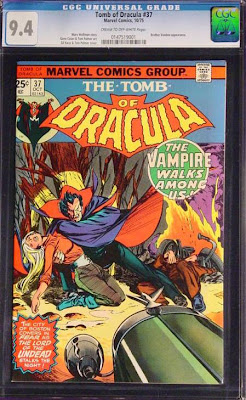
 "Slabbing" or "encasing" or "encapsulation" is a conservation technique that has been developed in early 2000 by a company called "Comics Guaranty LLC", also known as "CGC", based in Sarasota, Florida.
 The core business of the company is being a comic book grading service as an impartial third party. After it's launch it has since gone on to become an important yet controversial part of the comic book collecting community. The company has been described as "extremely important" to the comic book collection market by Robert Overstreet, author of the Overstreet Comic Book Price Guide, the bible in the comic book collecting field for everything grading and pricing your comic books. The encapsulation can be done either through an authorized dealer, directly by the owner through CGC's Internet partners, by paying an annual membership fee or via representatives in attendance at several comic book conventions. Upon receipt, the comics are inspected by five experts in a temperature- and humidity-controlled environment. The graders look for damage and signs of alteration. The comic books are then graded on a scale from 0.5 to 10. These numbers correspond with more traditional descriptive grades such as "very fine", "near mint", and "mint", with the higher numbers indicating a better grade. In addition to the numeric grade, CGC also uses color-coded labels to categorize comics like Universal (blue) for a standard comic book; Restored (purple) for a book that has evidence of restoration, either amateur (A) or professional (P), combined with the descriptors slight (S), moderate (M), or extensive (E) and Qualified (green) for a book with a significant defect that needs specific description or one with an unauthenticated signature.
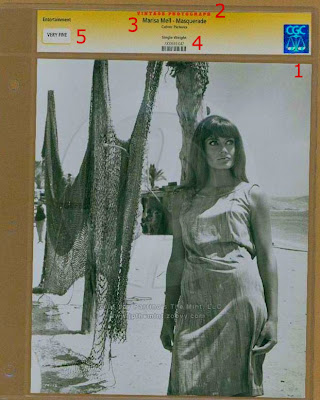
 After grading, the comics are placed in an inner well - a sealed sleeve of Barex, a highly gas-impermeable plastic polymer. Then, the comics are sonically sealed in a hard plastic, tamper-evident holder. This process is often referred in slang as "slabbing". A label with CGC hologram (1) is affixed at the top indicating the kind of collectable like "vintage photograph" (2), title like "Marisa Mell-Masquerade" (3), unique bar code (4) and grade like "Very Fine" (5).
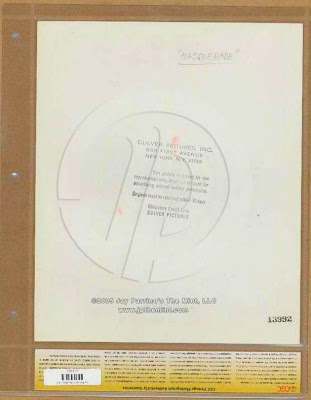 On first sight this kind of encapsulation looks like a great way to protect your comics. It gives them a sturdy case so that your comics will never be damaged. As a collector you are also sure that, thanks to the impartial expert grading to the highest grading standards in the field, you are buying or owning a comic book in the exact grade as mentioned and it has not been overgraded by a seller and sold to you for an inflated selling price. And last but not least thanks to the smart business techniques of the CGC in conjunction with Wizard Magazine, the dominant comic magazine in the field, a new comic book collecting market has emerged i.c. a speculator's market that specializes exclusively in (top) graded (vintage) comic books and thus willing to pay often many tenths of thousands of dollars above the normal collecting price for a near mint book but not encapsulated. Downside to this kind of encapsulation is that you will "never ever" going to read that comic book again in your life or any other life on the planet because once you open your sturdy case the value of comic book drops to the value of a normal graded uncapsulated comic book. Closing again by yourself as it was is not possible!
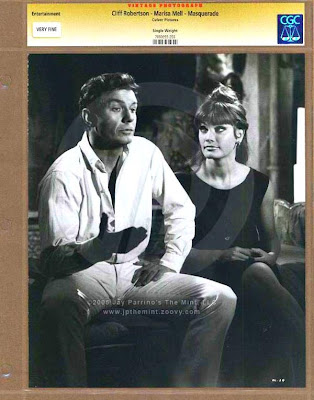 So now this technique of encapsulation is spilling over to other fields of collectability like vintage photos of (important) movies or movie stars. Buying such a encased photo will set you back at the moment around 40 USD or more while buying this photo without a CGC grade will cost you around 9.99 USD on Ebay or at other vintage movie memorabelia internet stores. I have no problem when people are trying to earn money by slabbing photos or whatever collectability. Everybody decides how to spend their hard earned money! Where I do have problem with is the fact that using this technique on vintage movie photos as a preservation or grade guarantee is kind of useless for almost all of those movie photos perhaps with the exception of some historical important ones. Most of those pictures are available in great quantities in excellent quality which does not warrant slabbing or selling at a premium price. The only person that is getting better is the seller, certainly not the buyer in thinking having a unique collector's item. A collector's market of those pictures does not exist to the extent of the comic book collector's market for vintage important comic books like Action Comics 1 as first appearance of Superman. So why do it???


