
During the height of the Spy Craze in the 60's around the world ignited by the monstrous success of the James Bond movies and franchise a new genre of movies surfaced build around the concept of the secret agent. Very quick in all segments of the media like television, books,... the secret agent appeared to save the world. The secret agent was not only restricted to the male agent but also the sexy female secret agents started to mingle in the deadly game to save the world. Best known from the 60's are "Honey West" played by Anne Francis, "Fathom Harvill" played by Raquel Welch or "Irma Eckman" played by Elke Summer.

Everybody tried to cash in on this money making machine so comics could not stay behind and soon the James Bond novels written by Ian Fleming were adapted into comics for news papers. Even in this medium, the secret agent concept wrecked havoc and was a run of the mill success. All over the world, secret agent comics were popping up. South America was no execption.

And where something in pop culture is a success, making fun of it soon follows so in 1968 a comic magazine in the style of the American magazine "Mad" under the name of "El Pingüino" based in Chili wanted a spoof comic making fun of the sexy female secret agent. Hence secret agent SATANKA. was born.

Satanka. is the sexy top secret agent working for an organisation called "C.I.D.R.A". In her quest to save the world from the evil organisation "SRONIA" she is helped by two other female agents known as "Rock" and "Roll".

Satanka. is the brain child of the Argentinian creator Hector German Oesterheld with the help of fellow Argentinian artist Angel "Lito" Fernandez. Herctor German Oesterheld or also known as "HGO" was one of Argentina's top comic book script writers. He was member of the Venice group who's members were also Mario Faustinelli, creator of "Kolosso", Hugo Pratt, creator of "Corto Maltesse" or Dino Battaglia, creator of "Ispettore Coke".

The sexy secret agent Satanka. was quite a succes in South America. So one day a journalist asked the creator Hector German Oesterheld where his inspiration came from to create his heroine. HGO answered that his femme fatale was modeled after the Austrian actress Marisa Mell. He told that Marisa Mell embodied physically everything that a secret agent should have and be to save the world. So Marisa Mell became Satanka. in the comics of the comic magazine "Pengüino". And this is not strange. Not many people in Europe and even the rest of world know that Marisa Mell in the 60's was a big star in South America. Her movies like "Danger: Diabolik!" or "Le Dolci Signori" were big hits in countries like Argentina and Chili. Her face and name were house hold. Like in Spain at that moment in time, she appeared almost every week on the cover of a magazine or in articles in the yellow press. Probably the 1965 movie "Masquerade" made quite an impression on HGO because in this movie Marisa Mell was the template for Satanka. as seen on the photo above.
And here this entry should have ended! Unfortunately it does not! Next to his profession as a comic book scripter, Hector German Oesterheld was also a critical journalist in Argentina situated on the left hand side of politics. In that capacity he wrote among others one of the best biographies of "Ernesto 'Che' Guevarra" also in 1968, the year that he created Satanka. or one of the most critical biographies of Evita Perron in 1970 making an end to the pop cultural idolization of her life. During the 70's, it is believed that HGO and his four adult daughters joined the leftish political organisation "Montoneros".

In 1976 Oesterheld disappeared to be never seen again. A year later his daughters, Diana (21), Beatriz (19), Estela (25) and Marina (18), were arrested by the Argentine armed forces in La Plata, and were also never seen again. Next his daughters' husbands were also among those that vanished. The dictorship in Argentina removed each and everyone against them. Only a grandson, Martín, born in captivity and recovered from the government by Oesterheld's widow, Elsa Sánchez, was rescued and raised by her. A second grandson, Fernando, born earlier, was raised by his paternal grandparents. When a journalist asked a member of the dictatorship what had happened to Oesterheld he aswered: "We did away with him because he wrote such a great biography of Che Guevara!" (Sigh!). Nobody knows what happened to Oesterheld, how he was tortured and ultimately died a cruel death around 1977-1978 but several other journalists in prison at the same time claim to have seen him alive in january of 1978. After that date all traces dispear in the mists of time! Sadly this is one story of many many many stories in Argentina. In our memories Hector German Oesterheld will always be remembered as a great artist and journalist. And that is something that no political regime can take away how hard and bloody they try to do. R.I.P. 
UPDATE - March 8th 2011
In this entry about the comic heroine "Satanka." I mentioned that: "He (HGO) was member of the Venice group who's members were also Mario Faustinelli, creator of "Kolosso", Hugo Pratt, creator of "Corto Maltesse" or Dino Battaglia, creator of "Ispettore Coke"."
I got a nice mail from an Argentinian journalist, comic expert on everything Argentinian comics and artist Carlos R. Martinez telling me that: "Osterheld was not a member of the Venice group. He worked with Hugo Pratt when this artist came to Argentina in 1950." Thanks Carlos for this clarification and info.
Carlos has a great own blog called
"Top-Comics: Blog sobre la historieta argentina y mundial creado por Luis Rosales (1944-2009)"
You can visit his blog at : http://luisalberto941.wordpress.com/
Highly recommended.


 And ready she was not! Being trained as a theatre and movie actress she had no idea what it required to be a musical actress. Although there is a lot in common between the two disciplines its major requirement is that, next to being a stage presence, you need to be trained as a musical singer. Not a common singer of pop songs or classical pieces but in the specific technique of using your singing voice on stage while acting. So you need to master two disciplines. And Marisa Mell was no singer. That was a talent she had not! She could dance, sword fight, ride a horse,... but singing she could not! Compare the 1995 re-recording of the musical sung by professional musical singers with the 1967 bootleg recording then you know what I mean. So the whole adventure in the USA turned into a disaster for her. After a try-out in Washington, D.C., the whole show was canceled and never got to Broadway much to dispair of Marisa Mell. She had high hopes that this production of "Mata Hari" would be her ticket to the USA and showbizz. It did not! She came back one year later very disappointed and desperate. People close to her mention that in fact she never recovered from it and was scarred for life! Others clame that this gave her carreer a whole other direction and was the beginning of her downfall as an A-list actress, once starring opposite Marcello Mastroianni in "Casanova 70".
 "Mata Hara" is only a footnote in the musical dictionaries mentioning the musical flop that it was. So there is not much material available on the memorabelia market. Luckily there is the bootleg recording of the production with the voices of the entire cast, including Marisa Mell, speaking her role as Mata Hari with a singing pitch! We are still waiting for original film footage of the production to appear. And now there are these pictures. In my knowledge they have never been published before in any magazine in the world since the days of the production. They show Marisa Mell during a dress rehearsel of the musical on stage. From today's point of view and even from the 60's point of view they are horrible. Marisa Mell had a very sexy slime figure in those days but by the looks of it the producers did everything to cover and distract from it. They are big, dark, depressive and formless cloths. Maybe they should have reflected the poverty of the character or the dispair from World War I. Even Audrey Hepburn in "My Fair Lady", starting out as Eliza Doolittle, the poor flower girl in Victorian London, had more beaufitul cloths than this. If these pictures give some kind of impression of the production quality than it is no wonder that, with everything else we know at the moment, this production was a faillure from the beginning. What is even more a mystery is that these cloths were drawn and made by Irene Sharaff, a 5-time Academy Award winner for productions like West Side Story, The King and I and... Cleopatra with Elisabeth Taylor. Maybe she had a headache the morning when she drew these cloths after a long night of partying and boozing in town? Who knows!
 So I was very pleased to hear from Marisa Mell fan "Dan" from Chicago that the movie-on-demand "Netflix" in the USA made this movie avalaible in her catalogue for the American audience. Knowing the quality of the prints and mostly the uncut versions of a movie they use this is really a treat for all Marisa Mell fans to see this movie for the first time in more than 40 years as it should been!
 So during my walk I wondered what it would be like to see a Marisa Mell film on a movie marquee during the end of the 60's and the beginning of the 70's when these were still around. Unfortunately, to my knowledge, there excist no pictures of these movie marquees with a Marisa Mell movie on it but thanks to the magic of the internet I created these marquees to get a sense what they might have looked like in the past!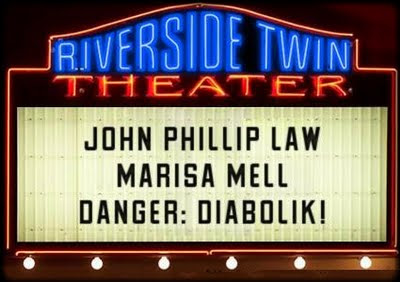


 The article starts by giving "Marisa Mell" a new name as "Melissa Mell". Then the writer gives us some revelations by telling us that we have here "...an instance which discounts the cynical view that beauty and brains make strange bedfellow. Melissa is a very successful actress which means that she is highly talented." and "...she is at present in Rome starring in "Luigi Zampa" and "...She is no stranger to British screens". Well, you have to admit that the writer did a hell of a job to write in only 5 sentences such a bullshit. This photo is a publicity still from her French 1966 movie "Objectif 500 millions" which had to have an accompanying publicity text with synopsis of the movie and credits of the people involved in creating this movie. How is it possible to change the name "Marisa Mell" into "Melissa Mell" with the correct information at hand? Maybe the writer was in need of new glasses and wrote the article while waiting before entering the pratice of an optician. Then we get another assumption that defies all logic. So now we know that to become a successfull actress you have to be highly talented. So all succesful actresses are talented? Sigh! Then we come to the next shocker! A new Marisa Mell movie that I have never heard of called "Luigi Zampa"! What??? The movie is actually called "Le Dolci Signore" and was directed by Luigi Zampa! And finally Marisa Mell is no stranger to British screens. That was an enormous exageration. I doubt it very much that the British cinema goer would have known when asked who Marisa Mell was or which movies she had played in. She was not a household name in England like Brigitte Bardot, Gina Lollobrigida, Sophia Loren, Elke Sommer... or other famous European actresses.


 In this movie Marisa Mell plays the role of "Paola" together with some of the best known female stars in European cinema at that moment: Claudine Auger, Virna Lisi and Ursula Andress.
 Ursula Andress has top billing on this movie and does not really need any introduction because she was the first Bond girl as "Honey Rider" in the first James Bond movie "Dr. No". Another Bond girl is also part of this team of liberated women, Claudine Auger from France. She was Bond's inside girl "Dominique - Domino - Derval" in the movie "Thunderball". And finally Lisi Virna from Italy, famous from euuuhhhh..., maybe from the Richard Burton starrer "Bluebeard" in 1972.
  The movie is build as a comedy around these four ladies with their stories involving the men in their lives played by Jean-Pierre Cassel, Frank Wolff, Mario Adorf and Lando Buzzanca. Although the movie has these four beautiful women as stars, the movie itself did not make any headlines. As a publicity vehicle it did do its job. The four sirens got tons of media attention in the latino world ranging from France, Italy, Spain to all the countries in Central and South America. Each and every magazine got them on the cover and had some kind of articles about them in their editions. For Marisa Mell the movie will be remembered for her sensual striptease. In the movie she is addicted to do stripteases and in the end her husband agrees with it and stimulates her.


